

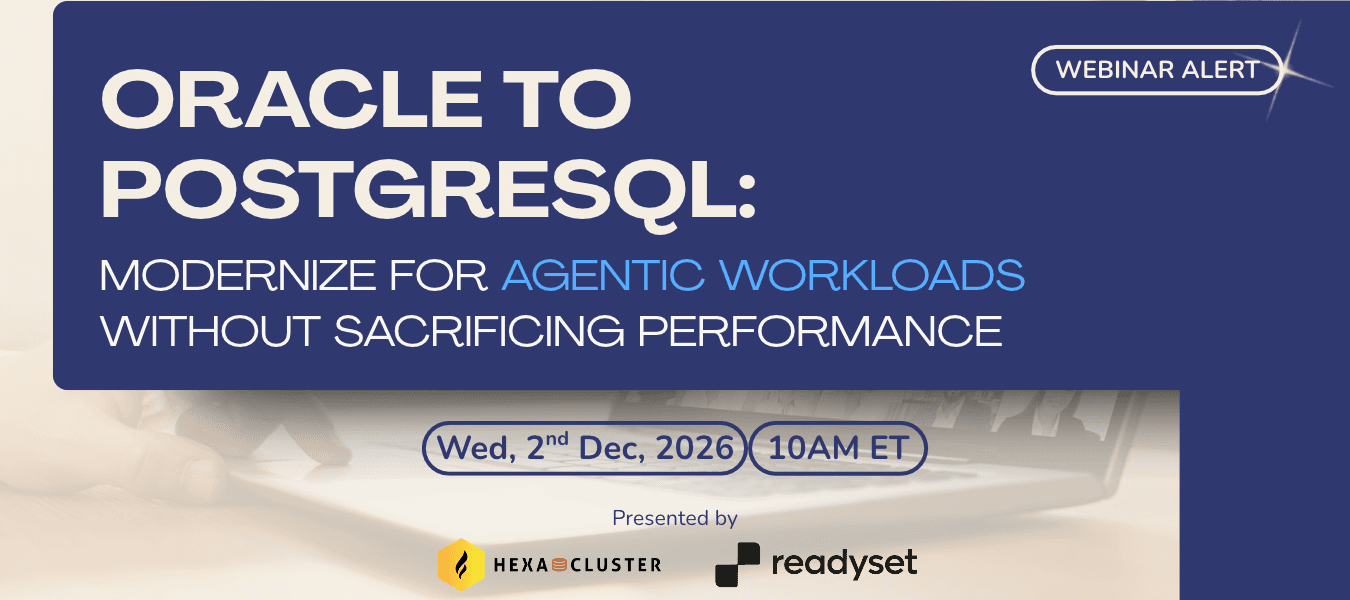
Oracle to PostgreSQL: Modernize for Agentic Workloads Without Sacrificing Performance
Register Here
Abstract
Oracle license cost, audit exposure and lock-in are pushing teams to PostgreSQL, and AI initiatives built on pgvector and an open extension ecosystem add to the pull. But the business case only holds if the migration is predictable and performance does not regress. That is where most programs stall.
AI agents raise the stakes. A single agent task can read user context, task state, memory and search results before it writes anything, so read traffic is heavier, burstier and full of repeated queries. Oracle features such as Result Cache and True Cache do not carry over to PostgreSQL, and the usual fix, adding read replicas, brings cost, replication lag and maintenance work.
In this joint session, HexaCluster and Readyset walk through the full path from Oracle to a PostgreSQL that is ready for agentic workloads.
HexaCluster covers where Oracle migrations go wrong: tricky data types, PL/SQL packages and DBMS_* and UTL_* calls, LOBs, the gap between first copy and live replication, and plan changes after cutover. You will see why deterministic, rule-based conversion is safer for production code than LLM-only conversion, and how HexaRocket assesses, converts, checks, moves data with log-based CDC and cuts over with a way back through reverse replication. A live demo runs on a real Oracle schema with PL/SQL packages, procedures and triggers.
Readyset then picks up where the migration ends. Its real-time cache sits between the application and PostgreSQL, recommends which queries to cache and stays in sync through the replication stream, with no code changes or manual invalidation. A live demo shows a slow query cached with one command, with latency and database load side by side. A field test on real GitLab traffic on Azure Postgres found 83% of query shapes cacheable and the slowest query cut from 85 ms to 3 ms, allowing the instance to be scaled down. The takeaway: size the database for writes and let the cache absorb agent reads, for the performance of up to 10 read replicas without the replica bill.
What attendees will learn
- Why teams are leaving Oracle now, and why migrations stall
- How to size a migration up front with an assessment before work starts
- How PL/SQL, packages and data are converted, validated and cut over with a fallback
- How to design the PostgreSQL target for read-heavy agent traffic, with vector data carried over
- How to replace Oracle caching features and absorb agent read load without adding read replicas
- How to cut database spend by sizing for writes and caching reads
Who should attend
- DBAs and database architects running Oracle
- PL/SQL and application developers
- platform and infrastructure engineers
- engineering leaders (VP Eng, CTO, Head of Data)
- teams already on PostgreSQL after an Oracle move
- and teams building AI or agent features.
Akhil Reddy Banappagari
Senior Software Developer
HexaCluster