
HexaCluster is back with its Summary of PostgreSQL in 2024 like our article in 2023. We would first like to thank all PostgreSQL Users, Contributors, Organizations, and Sponsors who have directly or indirectly contributed to an exponential growth, year over year, in PostgreSQL adoptions across the planet. PostgreSQL continues its legacy as one of the most powerful and flexible database management systems available. This article provides a Summary of PostgreSQL’s key achievements, developments, and updates in 2024.
The DB-Engines Rankings are a well-regarded resource in the tech world for tracking trends and changes in database technology. Updated on a monthly basis, these rankings highlight the most popular and widely used databases. For details about how the rankings are determined, you can refer to their documentation. Each year, DB-Engines names the DBMS of the Year by comparing popularity scores at the start and the end of the year.
While DB-Engines Rankings hasn’t yet announced the DBMS of the year, based on the statistics available so far, PostgreSQL continues to be one of the top scorers after Snowflake.
A quick Architecture Audit can save hours of troubleshooting later.
Try it Now!Let HexaRocket simplify it - migrate smarter, faster, and stress-free.
Contact us Today!HexaRocket performs end-to-end database migrations and replication seamlessly between Oracle, SQL Server, MySQL, MariaDB, and PostgreSQL.
Try Today!History of top scorers for the past few years.
Snowflake scoring the highest with PostgreSQL being the second highest in 2024.
In 2024, PostgreSQL achieved significant milestones in the AI ecosystem with new extensions as well as advancements in the pgvector extension.
pgvectorscale is an extension to enhance PostgreSQL’s capabilities for handling large-scale vector operations, enabling better scaling for machine learning and AI workloads.
StreamingDiskANN Index was Introduced as a new index type, this innovation provides efficient indexing for high-dimensional vector spaces, making PostgreSQL even more competitive in the vector database market.
With 9 releases in the Year 2024, there were both minor as well as major features implemented in pgvector. Following are some of the functionalities added to pgvector or optimized in 2024.
HNSW Index type was added to pgvector in 2023 but the support for parallel index builds existed for IVFFLAT Index types only. In early 2024, the parallel Index build support has been added to HNSW Index type. The overall performance of HNSW Index type has been optimized in the year 2024.
The memory utilization and WAL generation involved with HNSW Index builds is now reduced.
For efficient similarity search and advanced vector manipulation tasks, we now have new functions like halfvec, sparsevec, binary_quantize, hamming_distance, jaccord_distance, l2_normalize, subvector, supported by pgvector.
halfvec
The data type, vector, supported only up to 2000 dimensions. We now have the new types, halfvec to support up to 4000 dimensions and sparsevec to support up to 1000 non-zero elements.
There were multiple Performance improvements such as Improved cost estimation for better index selection, and iterative Index scans.
Many other fixes to resolve lock contention, errors, warnings and compilation errors.
These advancements solidify PostgreSQL as a robust choice for vector-based workloads.
PostgreSQL 17, released in 2024, brought a host of new features and enhancements.
VACUUM Improvements: A new memory management system for VACUUM reduces memory consumption and can improve overall vacuuming performance.
New Capabilities: Introduction of constructors, identity functions, and the JSON_TABLE() function, which converts JSON data into a table representation.
Query Performance: Enhancements for sequential reads using streaming I/O, improved write throughput under high concurrency, and optimized searches over multiple values in a B-tree index.
Failover Control: Improved failover mechanisms for logical replication.
New Utility: Introduction of pg_createsubscriber, a tool that creates logical replicas from physical standbys.
Upgrade Improvements: pg_upgrade now preserves logical replication slots on publishers and full subscription state on subscribers, allowing upgrades to future major versions to continue logical replication without requiring a resynchronization.
Direct TLS Handshake: A new client-side connection option, sslnegotiation=direct, performs a direct TLS handshake to avoid a round-trip negotiation.
New Role: MAINTAIN ROLE was introduced by which operations like VACUUM, ANALYZE, REINDEX, REFRESH MATERIALIZED VIEW, CLUSTER, and LOCK TABLE can be performed.
Incremental Backup: pg_basebackup now supports incremental backups.
COPY Enhancements: The COPY command adds a new option, ON_ERROR ignore, allowing a copy operation to continue in the event of an error.
A quick Architecture Audit can save hours of troubleshooting later.
Try it Now!Let HexaRocket simplify it - migrate smarter, faster, and stress-free.
Contact us Today!HexaRocket performs end-to-end database migrations and replication seamlessly between Oracle, SQL Server, MySQL, MariaDB, and PostgreSQL.
Try Today!In 2024, the PostgreSQL community released the following minor versions across supported major releases.
PostgreSQL 17: 17.0, 17.1, 17.2
PostgreSQL 16: 16.2, 16.3, 16.4, 16.5, 16.6
PostgreSQL 15: 15.6, 15.7, 15.8, 15.9, 15.10
PostgreSQL 14: 14.11, 14.12, 14.13, 14.14, 14.15
PostgreSQL 13: 13.14, 13.15, 13.16, 13.17, 13.18
PostgreSQL 12: 12.18, 12.19, 12.20, 12.21, 12.22 (Final minor version).
PostgreSQL 12 has reached End of Life (EOL) with its final release on November 21, 2024. No further updates or security fixes will be provided to this version going forward.
PostgreSQL 11 was already EOL since November 9, 2023. Users of PostgreSQL 11 and 12 are strongly recommended to upgrade to supported versions to ensure security and performance, upon testing.
Refer to the PostgreSQL Versioning policy for more details.
Description: PostgreSQL PL/Perl environment variable changes execute arbitrary code.
Major Versions Impacted: 17, 16, 15, 14, 13
Fixed in Minor Versions: 17.1, 16.5, 15.9, 14.14, 13.17
Component: Core server
Description: PostgreSQL SET ROLE, SET SESSION AUTHORIZATION reset to wrong user ID.
Major Versions Impacted: 17, 16, 15, 14, 13
Fixed in Minor Versions: 17.1, 16.5, 15.9, 14.14, 13.17
Component: Core server
Description: PostgreSQL libpq retains an error message from man-in-the-middle.
Major Versions Impacted: 17, 16, 15, 14, 13
Fixed in Minor Versions: 17.1, 16.5, 15.9, 14.14, 13.17
Component: Core server
Description: PostgreSQL relation replacement during pg_dump executes arbitrary SQL.
Major Versions Impacted: 16, 15, 14, 13
Fixed in Minor Versions: 16.4, 15.8, 14.13, 13.16
Component: Core server
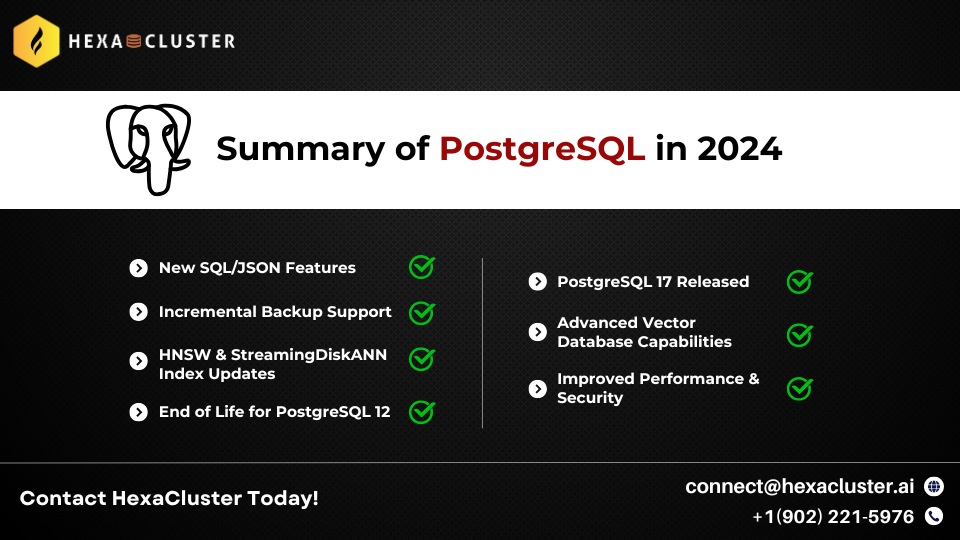
2024 has been another stellar year for PostgreSQL, with its growth, innovation, and unwavering commitment to excellence. With PostgreSQL 17 setting new benchmarks with its rich set of features and continuous improvements in vector database capabilities, PostgreSQL remains a trusted and versatile choice for developers and businesses worldwide. As the community gears up for 2025, we look forward to more groundbreaking advancements in this ever-evolving database ecosystem.
HexaCluster is a leader in Database Migrations and PostgreSQL Consulting. Contact us today to discuss your database migration challenges, PostgreSQL upgrade and other challenges.
As a proud creator and contributor of Ora2Pg, HexaCluster announced HexaRocket, to simplify database migrations using AI capabilities. HexaRocket simplifies Oracle to PostgreSQL migrations with more than 90% accuracy in migrating legacy PL/SQL Packages, Procedures and Functions to PostgreSQL seamlessly. Additionally, HexaRocket supports data migration and data replication between Oracle to PostgreSQL for online migrations. Contact us today or try HexaRocket for free.
Avi is the CEO and Co-founder of HexaCluster. Avi has a rich background in PostgreSQL, development, and machine learning. Before joining HexaCluster, he co-founded MigOps, a company dedicated to facilitating migrations to Open-Source databases like PostgreSQL. His journey in the PostgreSQL domain started at Dell followed by OpenSCG as a Database Architect and later joined Percona to start the PostgreSQL practice. Avi loves contributing to PostgreSQL, speaking at PostgreSQL conferences and writing PostgreSQL books.
Start your migration journey 🚀
start your migration journey with our expert team
Database & Application Migration Assessment Tool
End-to-End Database Migration & Modernization Tool
Database Code Object Conversion to PostgreSQL
MyBatis Mapper Conversion to PostgreSQL
Enterprise Data Replication & Live CDC
Oracle Compatibility Layer for PostgreSQL