
As part of its automated migration solution HexaRocket, to simplify Enterprise-grade Oracle to PostgreSQL database migrations, HexaCluster is pleased to announce a new PostgreSQL extension dedicated to Oracle compatibility.
When you migrate Oracle PL/SQL mail-sending code from Oracle to PostgreSQL, one of the interesting friction point is usually UTL_SMTP compatibility - you want the same call flow, similar parameters, and predictable failure behavior. pg_utl_smtp has been created by HexaCluster specifically for that, bringing Oracle UTL_SMTP-style procedures into PostgreSQL, so you can keep the migration timelines small. This article documents what pg_utl_smtp supports, what it does not support, and the practical UTL_SMTP compatibility limitations you should plan for, along with installation and usage instructions.
HexaRocket automatically adds compatibility to all such Oracle compatibility functionalities automatically, so, do not hesitate to ask us for a demo on HexaRocket.
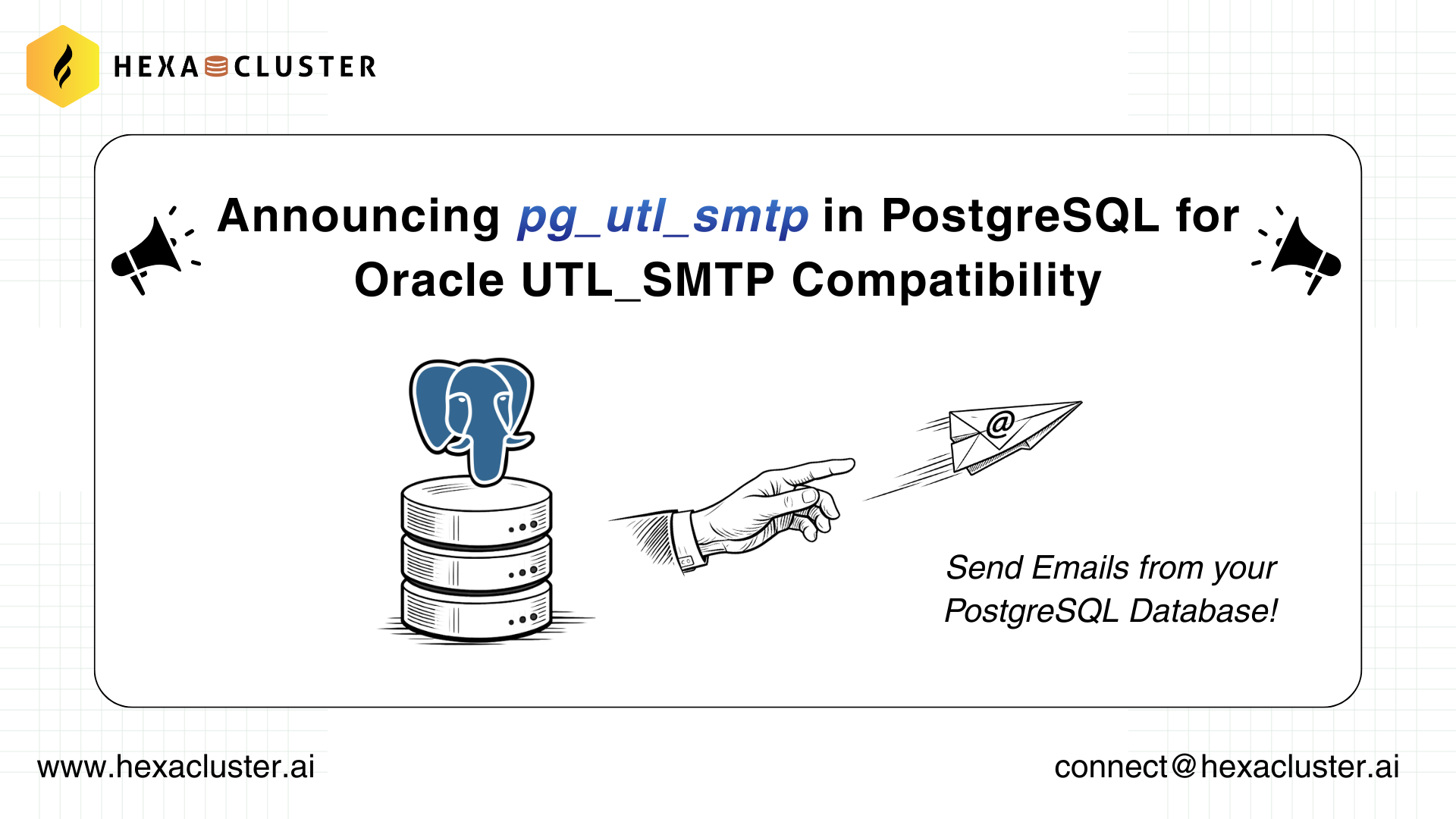
Beyond supporting migrations, this extension allows email notifications to be sent from triggers or stored procedures. By integrating the extension directly into the database, you can trigger data-driven actions without waiting for application intervention. Examples include security alerts and notifications when certain minimum thresholds are reached or to send reports directly from stored procedures.
A quick Architecture Audit can save hours of troubleshooting later.
Try it Now!Let HexaRocket simplify it - migrate smarter, faster, and stress-free.
Contact us Today!HexaRocket performs end-to-end database migrations and replication seamlessly between Oracle, SQL Server, MySQL, MariaDB, and PostgreSQL.
Try Today!When you migrate PL/SQL mail-sending code from Oracle UTL_SMTP to PostgreSQL, one of the interesting friction point is usually UTL_SMTP compatibility - you want the same call flow, similar parameters, and predictable failure behavior. pg_utl_smtp exists specifically for that, bringing Oracle UTL_SMTP-style procedures into PostgreSQL, so you can keep the migration timelines small. This article documents what pg_utl_smtp supports, what it does not support, and the practical UTL_SMTP compatibility limitations you should plan for, along with installation and usage instructions.
To install and get started with pg_utl_smtp, please follow the README.
Today, pg_utl_smtp implements these Oracle UTL_SMTP routines (procedural forms). This list was observed as the core SMTP happy-path needed for most send a simple email use cases, and it matches the typical operational sequence documented for Oracle UTL_SMTP.
These Oracle UTL_SMTP routines are not available yet in pg_utl_smtp. If you rely on any of those for your current Oracle UTL_SMTP implementation, let us know.
PROCEDURE send_mail
( p_to        IN VARCHAR2,
 p_from      IN VARCHAR2,
 p_subject   IN VARCHAR2,
 p_text_msg  IN VARCHAR2 DEFAULT NULL,
 p_html_msg  IN VARCHAR2 DEFAULT NULL,
 p_smtp_host IN VARCHAR2,
 p_smtp_port IN NUMBER DEFAULT 25)
AS
 l_mail_conn   UTL_SMTP.connection;
 l_boundary    VARCHAR2(50) := '----=*#abc1234321cba#*=';
BEGIN
 l_mail_conn := UTL_SMTP.open_connection(p_smtp_host, p_smtp_port);
 UTL_SMTP.helo(l_mail_conn, p_smtp_host);
 UTL_SMTP.mail(l_mail_conn, p_from);
 UTL_SMTP.rcpt(l_mail_conn, p_to);
 UTL_SMTP.open_data(l_mail_conn);

 UTL_SMTP.write_data(l_mail_conn, 'Date: ' || TO_CHAR(SYSDATE, 'DD-MON-YYYY HH24:MI:SS') || UTL_TCP.crlf);
 UTL_SMTP.write_data(l_mail_conn, 'To: ' || p_to || UTL_TCP.crlf);
 UTL_SMTP.write_data(l_mail_conn, 'From: ' || p_from || UTL_TCP.crlf);
 UTL_SMTP.write_data(l_mail_conn, 'Subject: ' || p_subject || UTL_TCP.crlf);
 UTL_SMTP.write_data(l_mail_conn, 'Reply-To: ' || p_from || UTL_TCP.crlf);
 UTL_SMTP.write_data(l_mail_conn, 'MIME-Version: 1.0' || UTL_TCP.crlf);
 UTL_SMTP.write_data(l_mail_conn, 'Content-Type: multipart/alternative; boundary="' || l_boundary || '"' || UTL_TCP.crlf || UTL_TCP.crlf);

 IF p_text_msg IS NOT NULL THEN
   UTL_SMTP.write_data(l_mail_conn, '--' || l_boundary || UTL_TCP.crlf);
   UTL_SMTP.write_data(l_mail_conn, 'Content-Type: text/plain; charset="iso-8859-1"' || UTL_TCP.crlf || UTL_TCP.crlf);
   utl_smtp.write_raw_data(l_mail_conn, utl_raw.cast_to_raw(p_text_msg));
   UTL_SMTP.write_data(l_mail_conn, UTL_TCP.crlf || UTL_TCP.crlf);
 END IF;

 IF p_html_msg IS NOT NULL THEN
   UTL_SMTP.write_data(l_mail_conn, '--' || l_boundary || UTL_TCP.crlf);
   UTL_SMTP.write_data(l_mail_conn, 'Content-Type: text/html; charset="iso-8859-1"' || UTL_TCP.crlf || UTL_TCP.crlf);

   UTL_SMTP.write_raw_data(l_mail_conn, utl_raw.cast_to_raw(p_html_msg));
   UTL_SMTP.write_data(l_mail_conn, UTL_TCP.crlf || UTL_TCP.crlf);
 END IF;
 UTL_SMTP.write_data(l_mail_conn, '--' || l_boundary || '--' || UTL_TCP.crlf);
 UTL_SMTP.close_data(l_mail_conn);

 UTL_SMTP.quit(l_mail_conn);
END;
You can now observe the same functionality and syntax compatibility to Oracle, in the following PostgreSQL procedure.
CREATE OR REPLACE PROCEDURE send_mail (
   p_to text,
   p_from text,
   p_subject text,
   p_text_msg text DEFAULT NULL,
   p_html_msg text DEFAULT NULL,
   p_smtp_host text DEFAULT NULL,
   p_smtp_port bigint DEFAULT 25
) AS $body$
DECLARE
 l_mail_conn   UTL_SMTP.connection;
 l_boundary    varchar(50) := '----=*#abc1234321cba#*=';

BEGIN

 l_mail_conn := UTL_SMTP.open_connection(p_smtp_host, p_smtp_port);
 CALL UTL_SMTP.helo(l_mail_conn, p_smtp_host);
 CALL UTL_SMTP.mail(l_mail_conn, p_from);
 CALL UTL_SMTP.rcpt(l_mail_conn, p_to);

 CALL UTL_SMTP.open_data(l_mail_conn);

 CALL UTL_SMTP.write_data(l_mail_conn, 'Date: ' || TO_CHAR(clock_timestamp(), 'DD-MON-YYYY HH24:MI:SS') || '\n');
 CALL UTL_SMTP.write_data(l_mail_conn, 'To: ' || p_to || '\n');
 CALL UTL_SMTP.write_data(l_mail_conn, 'From: ' || p_from || '\n');
 CALL UTL_SMTP.write_data(l_mail_conn, 'Subject: ' || p_subject || '\n');
 CALL UTL_SMTP.write_data(l_mail_conn, 'Reply-To: ' || p_from || '\n');
 CALL UTL_SMTP.write_data(l_mail_conn, 'MIME-Version: 1.0' || '\n');
 CALL UTL_SMTP.write_data(l_mail_conn, 'Content-Type: multipart/alternative; boundary="' || l_boundary || '"' || '\n' || '\n');

 IF p_text_msg IS NOT NULL THEN
   CALL UTL_SMTP.write_data(l_mail_conn, '--' || l_boundary || '\n');
   CALL UTL_SMTP.write_data(l_mail_conn, 'Content-Type: text/plain; charset="iso-8859-1"' || '\n' || '\n');
   CALL utl_smtp.write_raw_data(l_mail_conn, utl_raw.cast_to_raw(p_text_msg));
   CALL UTL_SMTP.write_data(l_mail_conn, '\n' || '\n');
 END IF;

 IF p_html_msg IS NOT NULL THEN
   CALL UTL_SMTP.write_data(l_mail_conn, '--' || l_boundary || '\n');
   CALL UTL_SMTP.write_data(l_mail_conn, 'Content-Type: text/html; charset="iso-8859-1"' || '\n' || '\n');

   CALL UTL_SMTP.write_raw_data(l_mail_conn, utl_raw.cast_to_raw(p_html_msg));
   CALL UTL_SMTP.write_data(l_mail_conn, '\n' || '\n');
 END IF;

 CALL UTL_SMTP.write_data(l_mail_conn, '--' || l_boundary || '--' || '\n');
 CALL UTL_SMTP.close_data(l_mail_conn);

 UTL_SMTP.quit(l_mail_conn);
END;
$body$
LANGUAGE PLPGSQL
SECURITY DEFINER
;
HexaCluster has developed and maintains several Oracle compatibility extensions to simplify your database migrations to PostgreSQL. Following are some of such extensions that can be very useful while you are migrating from Oracle to PostgreSQL, to avoid spending time on adding these features or creating workarounds.
Subscribe to our Newsletters and Stay tuned for more interesting topics.
Many enterprise applications designed for Oracle use UTL_SMTP to send automatic notifications. This extension from HexaCluster avoids rewriting all the email sending logic in the application layer, thus reducing database migration time and cost.
If you need expert support migrating legacy or complex Oracle, SQL Server, Sybase, MySQL, MariaDB databases to PostgreSQL or distributed databases, we’re here to help.
HexaCluster provides end-to-end migration and modernization services, including application migration and modernization, database migration, and PostgreSQL consulting such as performance tuning, health audits, managed DBA services, and 24/7/265 support.
To start a conversation or explore how we can support your migration journey, please contact us at connect@hexacluster.ai
Avi is the CEO and Co-founder of HexaCluster. Avi has a rich background in PostgreSQL, development, and machine learning. Before joining HexaCluster, he co-founded MigOps, a company dedicated to facilitating migrations to Open-Source databases like PostgreSQL. His journey in the PostgreSQL domain started at Dell followed by OpenSCG as a Database Architect and later joined Percona to start the PostgreSQL practice. Avi loves contributing to PostgreSQL, speaking at PostgreSQL conferences and writing PostgreSQL books.
Gilles Darold is the CTO of HexaCluster. Gilles is one of the Major PostgreSQL Contributors and the creator of Ora2Pg, pgBadger, and many more popular PostgreSQL tools and extensions. His leadership has enabled HexaCluster in contributing to 50 plus popular PostgreSQL extensions and also create multiple PostgreSQL tools and extensions. Gilles is an expert in all the popular programming languages and is always passionate about contributing to PostgreSQL.
Start your migration journey 🚀
start your migration journey with our expert team
Database & Application Migration Assessment Tool
End-to-End Database Migration & Modernization Tool
Database Code Object Conversion to PostgreSQL
MyBatis Mapper Conversion to PostgreSQL
Enterprise Data Replication & Live CDC
Oracle Compatibility Layer for PostgreSQL