
Oracle has finally introduced support for the Boolean data type in the release 23ai. Many thanks to the Engineers at Oracle for implementing this data type for an optimal performance. PL/SQL had BOOLEAN for decades, but developers were not able to declare native boolean type for columns of tables. For this reason, developers returned VARCHAR2/NUMBER from functions instead of BOOLEAN. Interestingly, PostgreSQL, an open-source relational database that has been widely used for many years and a migration target for Oracle, has had support for Boolean data for more than the past two decades. In this article, we will discuss about the workarounds used by developers before Oracle adopted boolean, and how it works in PostgreSQL.

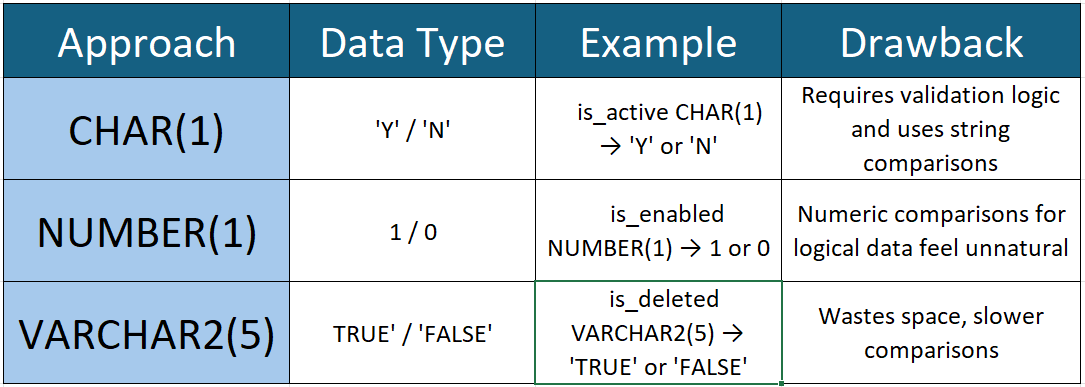
Each of them may add redundant conversions and conditions in application code and PL/SQL functions, leading to more CPU work and larger indexes.
A quick Architecture Audit can save hours of troubleshooting later.
Try it Now!Let HexaRocket simplify it - migrate smarter, faster, and stress-free.
Contact us Today!HexaRocket performs end-to-end database migrations and replication seamlessly between Oracle, SQL Server, MySQL, MariaDB, and PostgreSQL.
Try Today!While Oracle took 2 decades to bring this up, PostgreSQL had it forever. Postgres stores Boolean values efficiently (internally as a single byte) and allows direct logical operations as follows.
SELECT * FROM employees WHERE is_active;UPDATE orders SET is_verified = TRUE WHERE id = 1001;
What this clearly means is that it requires - No conversions, no string comparisons, just clean, logical semantics. This approach results in simpler queries, smaller indexes, and faster filtering, especially in analytical workloads with millions of rows.
Following chart demonstrates us the table structure in both Oracle and PostgreSQL, where we can avoid the additional checks in the case of PostgreSQL but not in Oracle.
| Oracle Table Structure before 23ai | Equivalent PostgreSQL Table Structure |
|---|---|
CREATE TABLE user_flags (
   user_id     NUMBER GENERATED BY DEFAULT AS IDENTITY PRIMARY KEY,
   is_active   CHAR(1) CHECK (is_active IN ('Y', 'N')),
   is_verified NUMBER(1) CHECK (is_verified IN (0, 1))
);
|
CREATE TABLE user_flags (
   user_id     INTEGER GENERATED BY DEFAULT AS IDENTITY PRIMARY KEY,
   is_active   BOOLEAN,
   is_verified BOOLEAN
);
|
Insert Statements
You can directly insert TRUE and FALSE if boolean is supported natively, as seen in the case of PostgreSQL.
| Oracle Compatible Insert before 23ai | PostgreSQL Compatible Insert |
|---|---|
INSERT INTO user_flags (is_active, is_verified)
VALUES ('Y', 1);
|
INSERT INTO user_flags (is_active, is_verified) VALUES (TRUE, TRUE); |
Select Statements
You can see simplified and performant select statements as seen in the table below.
| Oracle | PostgreSQL |
|---|---|
SQL> SELECT * FROM genericmini_cdc.user_flags WHERE is_active = 'Y' AND is_verified = 1; |
postgres=# SELECT * FROM user_flags WHERE is_active AND is_verified; |
In a nutshell, we can see boolean as the optimal data type over other relevant alternatives. Some of such benefits are listed in the table below.
| Aspect | BOOLEAN | CHAR(1) / CHAR(5) | SMALLINT / NUMBER(1) |
|---|---|---|---|
| Meaning | Explicit logical type with TRUE, FALSE, and NULL | Textual convention (e.g., 'Y', 'N', 'YES', 'NO') | Numeric convention (1 = true, 0 = false) |
| Storage | Typically 1 byte or bit | 1–5 bytes depending on length and encoding | 1–2 bytes |
| Type Safety | Accepts only logical truth values | May store invalid text (e.g., 'A', '?') | May store non-logical numbers (e.g., 2, -1) |
| Query Simplicity | Supports direct logical operations (AND, NOT, IS TRUE) | Requires explicit comparison (='Y') | Requires explicit comparison (=1) |
| Value Interpretation | Automatically interprets TRUE, FALSE, T, F, YES, NO, 1, 0 (case-insensitive) | Interpretation depends on convention and case sensitivity | Limited to numeric values; cannot represent textual forms |
| Readability | Self-explanatory and standardized | Convention-dependent and less portable | Convention-dependent and less intuitive |
| Language Integration | Maps directly to native Boolean types | Requires conversion logic | Requires conversion logic |
To simplify end-to-end database migrations from Oracle to PostgreSQL, we have announced our tool called Hexarocket. One of the advantages of using this tool is that - during data migration from Oracle to PostgreSQL, it can automatically map CHAR(1) and NUMBER(1) of Oracle to BOOLEAN in PostgreSQL.
Are you looking to migrate from Oracle to PostgreSQL or SQL Server to PostgreSQL? We are here to support with a simple and seamless migration experience within few clicks using HexaRocket. Request us for a demo on HexaRocket today: Schedule a demo.

Pavan is a PostgreSQL Database Engineer and Developer at HexaCluster. With expertise in database migrations, performance tuning, and highly scalable PostgreSQL deployments, Pavan is considered one of the most loved PostgreSQL DBA and Developer by the Customers of HexaCluster. His expertise is not limited to PostgreSQL administration, development and migrations. Pavan is a seasoned developer who can build scalable applications using Golang, Java and Python languages.
Start your migration journey 🚀
start your migration journey with our expert team
Database & Application Migration Assessment Tool
End-to-End Database Migration & Modernization Tool
Database Code Object Conversion to PostgreSQL
MyBatis Mapper Conversion to PostgreSQL
Enterprise Data Replication & Live CDC
Oracle Compatibility Layer for PostgreSQL